Latest Botanical & Nutraceutical Insights
Discover expert research, clinical evidence, and industry analysis on active botanical ingredients and natural health solutions.
2026 How to Source Centella Asiatica Extract?
Table of Contents
- What Is Centella Asiatica Extract and Why Is It Sourced?
- How to Define Extract Specifications and Quality Requirements
- Where to Find Reliable Centella Asiatica Extract Suppliers
- How to Evaluate Supplier Credentials, Testing, and Compliance
- How to Manage Pricing, Samples, Orders, and Ongoing Supply
- FAQS
- Conclusion
- Related Posts
Sourcing Centella Asiatica Extract in 2026 requires more than comparing prices or checking a supplier’s website. Demand is moving toward traceable, standardized botanical ingredients. Grand View Research’s 2024 botanical extracts analysis identifies cosmetics, personal care, and nutraceuticals as major growth areas. Its findings also emphasize clean-label expectations and documented supply chains. These trends make origin, processing, and testing commercially important.
Start with the plant itself.
Centella asiatica may be cultivated in different climates, soils, and farming systems. Those conditions can influence triterpene levels, color, odor, and extraction performance. The WHO monograph on Centella asiatica highlights recognized marker compounds, including asiaticoside, madecassoside, asiatic acid, and madecassic acid. A serious supplier should explain which markers are controlled. “Standardized extract” is not enough.
The 2024 IMARC analysis of botanical ingredients also points to stronger demand for quality assurance and application-specific formulations. Buyers should request the botanical identity, plant part, extraction solvent, ratio, marker assay, microbiological results, heavy-metal testing, pesticide screening, and batch traceability. HPLC data is especially useful when comparing two extracts with similar labels. A neat certificate can still hide weak sourcing.
That deserves reflection.
No single report can replace an audit, retained samples, or a stability review. Supplier experience matters, but evidence matters more. In 2026, the best sourcing process will connect farm records, extraction controls, laboratory verification, and final product performance. This guide explains how to evaluate Centella Asiatica Extract with practical questions, reliable documentation, and enough skepticism to avoid expensive surprises.
What Is Centella Asiatica Extract and Why Is It Sourced?
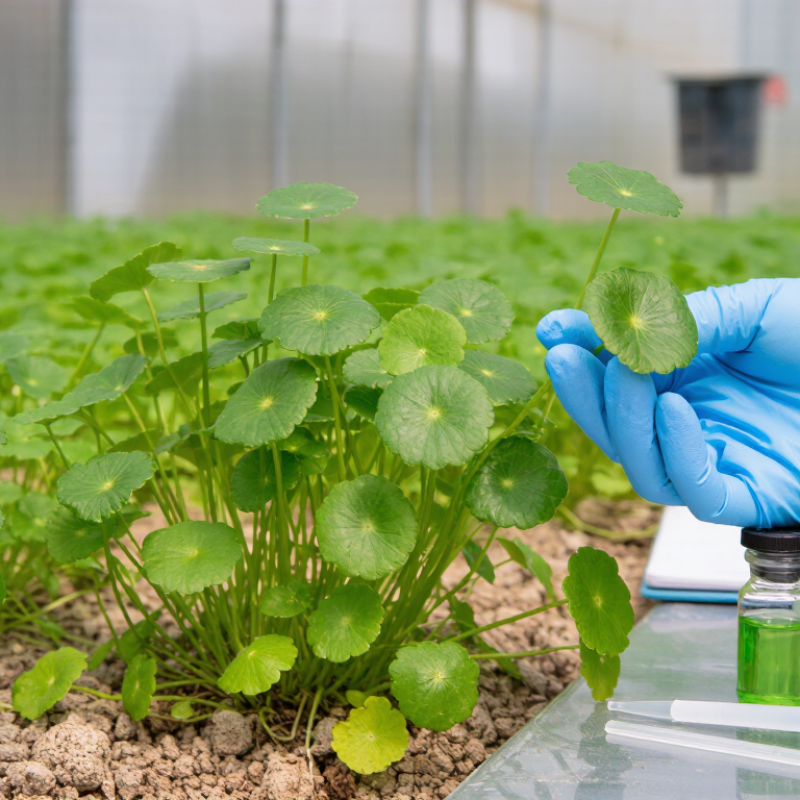
Centella asiatica extract is a concentrated botanical ingredient made from the plant’s leaves, stems, or aerial parts. It is often selected for cosmetic and personal-care formulations because it contains triterpenes such as asiaticoside, madecassoside, asiatic acid, and madecassic acid. These compounds may vary by plant part, harvest season, geography, and extraction method. The extract is not simply dried centella powder. Its chemical profile depends on how the plant is grown, processed, and stored.
Sourcing matters because consistent identity supports reliable formulation work. A responsible supplier should provide the botanical name, plant part, country of origin, extraction solvent, carrier ingredients, and standardization range. The field story matters. Traceable cultivation records can show when plants were harvested and how they were handled before extraction. Poor drying may increase moisture, discoloration, or microbial risk. Visual color alone cannot prove identity. Laboratory testing should examine marker compounds, heavy metals, pesticides, microbial limits, and residual solvents where relevant.
In practice, a certificate alone is not enough. I would compare the specification with an independent test report and request a retained sample for evaluation. Small differences in odor, color, or solubility can affect a finished formula. Even well-managed supply chains can vary between seasons. That limitation deserves attention, not concealment. Clear documentation, botanical authentication, and batch-level testing make sourcing decisions more defensible. Supplier communication also matters, especially when the extract uses preservatives or carrier materials that change the declared composition.
2026 How to Source Centella Asiatica Extract?
Key Triterpenes Used for Extract Identity and Quality Control
Centella asiatica extract is commonly evaluated through its characteristic triterpenes. Asiaticoside and madecassoside are glycosides, while asiatic acid and madecassic acid are aglycones. When sourcing an extract, buyers should request botanical identification, extraction details, batch-specific marker testing, contaminant screening, and a certificate of analysis. Molecular weights are calculated from the compounds’ published molecular formulas using standard atomic weights.
How to Define Extract Specifications and Quality Requirements
When sourcing Centella asiatica extract in 2026, treat the specification as a purchasing map. Define the botanical identity, plant part, extraction solvent, extract ratio, and physical form. Specify marker compounds, such as total triterpenes, with an acceptable range. Avoid vague claims like “high potency.” They create disputes later. Set limits for moisture, microbial counts, heavy metals, pesticides, and residual solvents. The required limits should match the product’s use and local regulations.
Quality also depends on evidence beyond the certificate. Request cultivation records, harvest details, processing dates, storage conditions, and full traceability. Use independent laboratory testing for identity and key contaminants when the material is new. A supplier’s document may be accurate, but it is not automatic proof. I have seen specifications that looked complete yet lacked a clear sampling plan. That is a weakness worth correcting. Include packaging requirements, shelf-life data, retain samples, and change-control notification. If the extraction process changes, the specification should be reviewed again. Use validated or recognized analytical methods where available, and record every acceptance decision clearly.
Where to Find Reliable Centella Asiatica Extract Suppliers
Reliable sourcing starts with supplier verification, not a low quotation. Ask for legal business details, facility information, and a current product specification. The supplier should identify Centella asiatica by botanical name, plant part, extraction method, and solvent. Request a representative sample before approving a larger order. In practice, color and odor can vary naturally. That is normal. However, unexplained variation deserves questions. A clear traceability system should connect each lot to raw-material records, processing dates, and shipment documents.
A dependable supplier provides a lot-specific certificate of analysis, not only a generic template. Check marker compounds, microbial limits, heavy metals, pesticides, residual solvents, and moisture. Confirm the laboratory, testing methods, reporting units, and specification limits. Independent testing is especially useful for the first purchase. I have learned that attractive paperwork can still leave gaps. One certificate may not prove every batch. Review stability data, storage conditions, packaging, shelf life, and minimum order quantities. For imported materials, verify customs documents and applicable local requirements before payment. Ask how complaints, recalls, and rejected lots are handled. These answers reveal operational maturity.
Tips: Compare at least three qualified suppliers. Keep sealed samples from every lot. Use a written approval checklist. Do not rely on photos. A small pilot order can expose delays, weak packaging, or inconsistent communication. Recheck specifications after process changes. This step is easy to overlook, even for experienced buyers.
How to Evaluate Supplier Credentials, Testing, and Compliance
When sourcing Centella asiatica extract in 2026, supplier credentials deserve close attention. A polished website proves very little. Request current business registration, manufacturing licenses, quality certificates, and documented facility addresses. Check whether certificates match the actual production site. In practice, mismatched addresses can signal weak oversight.
Ask for a recent certificate of analysis from the same batch. It should identify the botanical name, plant part, extraction method, marker compounds, and batch number. Review testing for heavy metals, pesticides, microbial contamination, and residual solvents. Use independent laboratory results when possible. Do not rely only on supplier-provided summaries. Testing details matter. Methods, detection limits, and laboratory accreditation should be visible. A vague “passed” statement is not enough.
Compliance also requires traceability from cultivation to shipment. Request harvest records, origin information, allergen statements, safety data, and storage conditions. Confirm that packaging protects the extract from heat, moisture, and light. Audit responses reveal practical expertise. Ask how deviations, complaints, and product recalls are handled. Their answers should be specific, not rehearsed. Supplier audits can uncover gaps that documents hide. However, one audit cannot guarantee every future batch. I would keep reserve samples and schedule periodic verification. That extra work may seem excessive, yet botanical materials naturally vary. A reliable supplier explains those variations and supports evidence-based specifications. Credentials are only the starting point. Consistent testing builds confidence.
| Evaluation Dimension | What to Verify | Recommended Evidence or Test Data | Practical Acceptance Criteria | Priority |
|---|---|---|---|---|
| Botanical identity | Confirm that the raw material is Centella asiatica and not a similar-looking botanical. Verify the plant part, such as herb, leaf, or aerial parts. | Botanical specification, supplier identification procedure, macroscopic and microscopic examination, and an authenticated reference sample. | Scientific name, plant part, country of origin, and batch documentation must match the purchasing specification. | Critical |
| Plant origin and traceability | Review cultivation or collection location, harvest season, agricultural practices, and the route from farm or collector to processor. | Lot-specific traceability records, harvest records, supplier map, chain-of-custody documentation, and recall procedure. | Every finished extract batch should be traceable to its raw-material lot and processing records. | Critical |
| Extract type and ratio | Identify whether the material is a dry extract, liquid extract, tincture, or standardized extract. Confirm the native extract ratio, such as 4:1 or 10:1, only when supported by manufacturing records. | Product specification, manufacturing flow chart, solvent information, extraction yield calculation, and batch manufacturing record. | Extract ratio and physical form must be clearly defined and consistent across the quotation, specification, certificate of analysis, and label. | Critical |
| Marker compounds | Assess the declared triterpenes, including asiaticoside, madecassoside, asiatic acid, and madecassic acid, according to the intended application. | Validated HPLC or UPLC method, chromatogram, reference standards, assay result, and method validation summary. | Use a defined marker profile and a justified assay range. Do not accept a generic “total triterpenes” claim without a test method and calculation basis. | Critical |
| Identity testing | Confirm the extract fingerprint and distinguish it from adulterated, substituted, or incorrectly identified plant material. | HPTLC, HPLC or UPLC fingerprint, reference chromatogram, and, when appropriate, DNA-based botanical authentication. | Sample fingerprint should be consistent with the approved reference profile and show no unexplained major peaks. | Critical |
| Residual solvents | Determine whether ethanol, water, acetone, ethyl acetate, or other solvents were used during extraction and concentration. | Lot-specific residual-solvent report using a validated GC method and a declared solvent process. | Results should comply with the applicable market requirements and the relevant ICH Q3C solvent limits where applicable. | High |
| Heavy metals and elemental impurities | Evaluate lead, arsenic, cadmium, and mercury, with additional elements assessed when justified by the growing region or process. | ICP-MS or ICP-OES test report from a qualified laboratory, including units, detection limits, and sample preparation details. | Results must meet the destination-market limits and the buyer’s internal limits for the intended product category. | Critical |
| Pesticide residues | Check for agricultural chemicals relevant to the source country and destination market, including prohibited or restricted pesticides. | Multi-residue GC-MS/MS and LC-MS/MS report, analyte list, reporting limits, and sampling plan. | No prohibited pesticide should be detected. Other residues should comply with applicable maximum residue limits or buyer-defined limits. | Critical |
| Microbiological quality | Review total aerobic microbial count, total yeast and mold count, and specified pathogens appropriate to the product category. | Lot-specific microbiological certificate of analysis from a competent laboratory. | Limits should be established according to the intended use, such as cosmetic, food, or supplement, and should include absence criteria for relevant pathogens. | Critical |
| Mycotoxins and contamination risks | Assess aflatoxins and other contaminants when the botanical origin, climate, drying conditions, or storage history creates a credible risk. | Risk assessment and, where required, LC-MS/MS or HPLC testing for relevant mycotoxins. | Testing frequency should be risk-based, with results below the applicable legal or customer limits. | High |
| Physical and chemical specifications | Verify appearance, color, odor, taste where relevant, moisture or loss on drying, pH for liquids, bulk density, and solubility or dispersibility. | Approved specification, standard test methods, representative retain sample, and three-batch consistency data. | Parameters should have numerical limits or clear descriptive standards rather than subjective wording alone. | High |
| Excipients and carriers | Identify carriers such as maltodextrin, gum acacia, or other processing aids. Confirm whether they affect active-content calculations or allergen status. | Full composition statement, carrier percentage, allergen declaration, GMO statement, and food-contact or cosmetic suitability documents where relevant. | All carriers and processing aids must be declared and permitted for the intended application and market. | High |
| Adulteration and undeclared substances | Screen for undeclared pharmaceutical ingredients, synthetic marker compounds, dyes, fillers, or substitution with other botanicals. | Risk-based adulterant screen, chromatographic fingerprint, supplier declaration, and independent confirmation for high-risk lots. | No undeclared active pharmaceutical ingredient, synthetic marker, unauthorized colorant, or non-declared botanical should be present. | Critical |
| Supplier quality system | Evaluate documented quality management, change control, deviation handling, CAPA, complaint handling, training, and document retention. | Quality manual, audit questionnaire, recent audit report, CAPA examples, organization chart, and quality agreement. | Supplier should demonstrate controlled procedures and the ability to investigate out-of-specification results and market complaints. | Critical |
| Manufacturing standards | Confirm that production controls are appropriate for the intended use, including botanical, cosmetic, food, or dietary-supplement applications. | Current GMP or equivalent certificate, scope of certification, site-audit results, sanitation records, and process-control documents. | Certification scope must cover the actual manufacturing site and product category; certificates should be current and independently verifiable. | Critical |
| Certificate of analysis quality | Check whether the certificate is batch-specific, complete, signed or electronically approved, and linked to the actual specification. | Sample certificate showing batch number, manufacturing date, retest or expiry date, methods, results, units, and approval status. | Every shipped lot should have a certificate that matches the physical batch and includes all agreed critical tests. | Critical |
| Laboratory competence | Assess whether internal and external laboratories use suitable methods, qualified analysts, calibrated instruments, and controlled reference standards. | Laboratory accreditation or qualification records, method validation, proficiency testing, calibration certificates, and audit trail controls. | Critical assays and contamination tests should be performed using validated or appropriately verified methods. | High |
| Stability and shelf life | Review stability under recommended storage conditions and confirm whether marker compounds, moisture, color, and microbiological quality remain controlled. | Real-time and accelerated stability data, packaging evaluation, storage conditions, and retest or expiry rationale. | Shelf life should be supported by data from the same or comparable formulation, packaging, and manufacturing process. | High |
| Packaging and storage | Confirm protection from moisture, heat, light, oxygen, and contamination during storage and transportation. | Packaging specification, container-closure information, transport conditions, warehouse records, and temperature or humidity requirements. | Packaging must be suitable for the powder or liquid form and include batch identification, net quantity, storage conditions, and expiry or retest information. | High |
| Regulatory documentation | Match the documentation to the destination market and intended use. Avoid treating one certificate as proof of global regulatory compliance. | Technical data sheet, safety data sheet where applicable, specification, allergen statement, GMO statement, origin statement, and regulatory questionnaire. | Documents should be current, internally consistent, and reviewed against the specific requirements of the importing country and product category. | Critical |
| Claims and labeling support | Separate measurable quality claims from therapeutic or cosmetic performance claims that may require substantiation or regulatory review. | Approved label information, claim-support dossier, assay basis, recommended use level, and legal or regulatory review record. | Only supported, permitted claims should be used. A standardized marker level does not by itself prove clinical efficacy. | High |
| Commercial and supply continuity | Review minimum order quantity, lead time, annual capacity, forecast process, safety stock, alternate sites, and raw-material availability. | Capacity statement, lead-time history, supply-continuity plan, business-continuity procedure, and approved change-notification terms. | Supplier should provide advance notice of changes to source, process, specification, site, or packaging and maintain agreed service levels. | Medium |
| Pre-approval sampling | Compare samples from multiple production lots rather than approving a single promotional sample. | Blind three-lot evaluation, independent testing, sensory comparison, assay comparison, and pilot-scale compatibility test. | Samples should meet the approved specification and show acceptable lot-to-lot consistency before commercial qualification. | Critical |
How to Manage Pricing, Samples, Orders, and Ongoing Supply
Sourcing Centella asiatica extract in 2026 requires more than comparing the price per kilogram. Pricing may include extraction, testing, packaging, freight, and customs documents. Request a written quotation with the plant part, extraction solvent, active markers, assay method, minimum order quantity, shelf life, and delivery terms. Check whether the quoted price applies to one batch or a longer supply agreement. Keep every detail in one comparison sheet. Small omissions can become expensive later.
Begin with a practical sample request. Ask for enough material to test color, odor, solubility, and marker content under your own process conditions. Do not judge it by appearance alone. Request the batch number, certificate of analysis, safety data sheet, and relevant contaminant testing. Confirm whether the sample represents current production stock. A sample from an old lot may create false confidence. I would also record the date received and storage temperature, although this step is easy to overlook.
Before placing an order, confirm payment timing, packaging, lot traceability, production lead time, and change-notification procedures. Ask how the supplier manages harvest-season variation and unexpected raw-material shortages. A staged order can reduce risk, but it may increase freight costs. Maintain safety stock according to actual consumption, not optimistic forecasts. Review quality and delivery performance after every shipment. Some plans will need adjustment. That is normal. Reliable supply depends on clear records, honest communication, and decisions based on tested material rather than attractive promises.
FAQS
Define the botanical identity, plant part, solvent, extract ratio, and physical form. Keep it specific.
State the marker compounds and acceptable ranges, such as total triterpenes. Avoid vague terms like “high potency.”
Set limits for moisture, microbes, heavy metals, pesticides, and residual solvents. Match them to intended use and local regulations.
It connects test results to one production batch. Check methods, detection limits, and laboratory accreditation.
No. Request chromatographic fingerprints and review three recent batches. Variation happens. Hidden variation needs investigation.
Request cultivation records, harvest details, origin information, processing dates, storage conditions, and shipment records.
Check current registration, manufacturing licenses, quality certificates, and facility addresses. The documents should match the actual site.
Packaging should protect the extract from heat, moisture, and light. Review shelf life, retain samples, and storage conditions.
They verify identity and important contaminants, especially for new materials. Supplier documents are helpful, but not automatic proof.
Ask about deviations, complaints, recalls, and process changes. Schedule periodic verification and keep reserve samples. One audit is not enough.
Conclusion
Sourcing Centella Asiatica Extract requires more than simply finding a low-cost ingredient. Buyers should first understand the extract’s intended use, botanical identity, extraction method, concentration, and suitable format. Clear specifications should define active compounds, appearance, odor, solubility, microbiological limits, heavy metal limits, residual solvents, shelf life, packaging, and storage conditions. These requirements help ensure the material is consistent, safe, and compatible with the final product.
Reliable suppliers can be identified through industry networks, professional exhibitions, verified directories, and direct manufacturer communication. Before placing an order, evaluate their production capabilities, quality management systems, documentation, certificates, batch records, and independent testing procedures. Request representative samples and compare them against agreed specifications before approving a larger purchase. Pricing should be assessed alongside quality, minimum order quantities, lead times, shipping conditions, payment terms, and supply stability. Regular communication, batch testing, and performance reviews can support dependable long-term sourcing of Centella Asiatica Extract.

Blog Tags: